
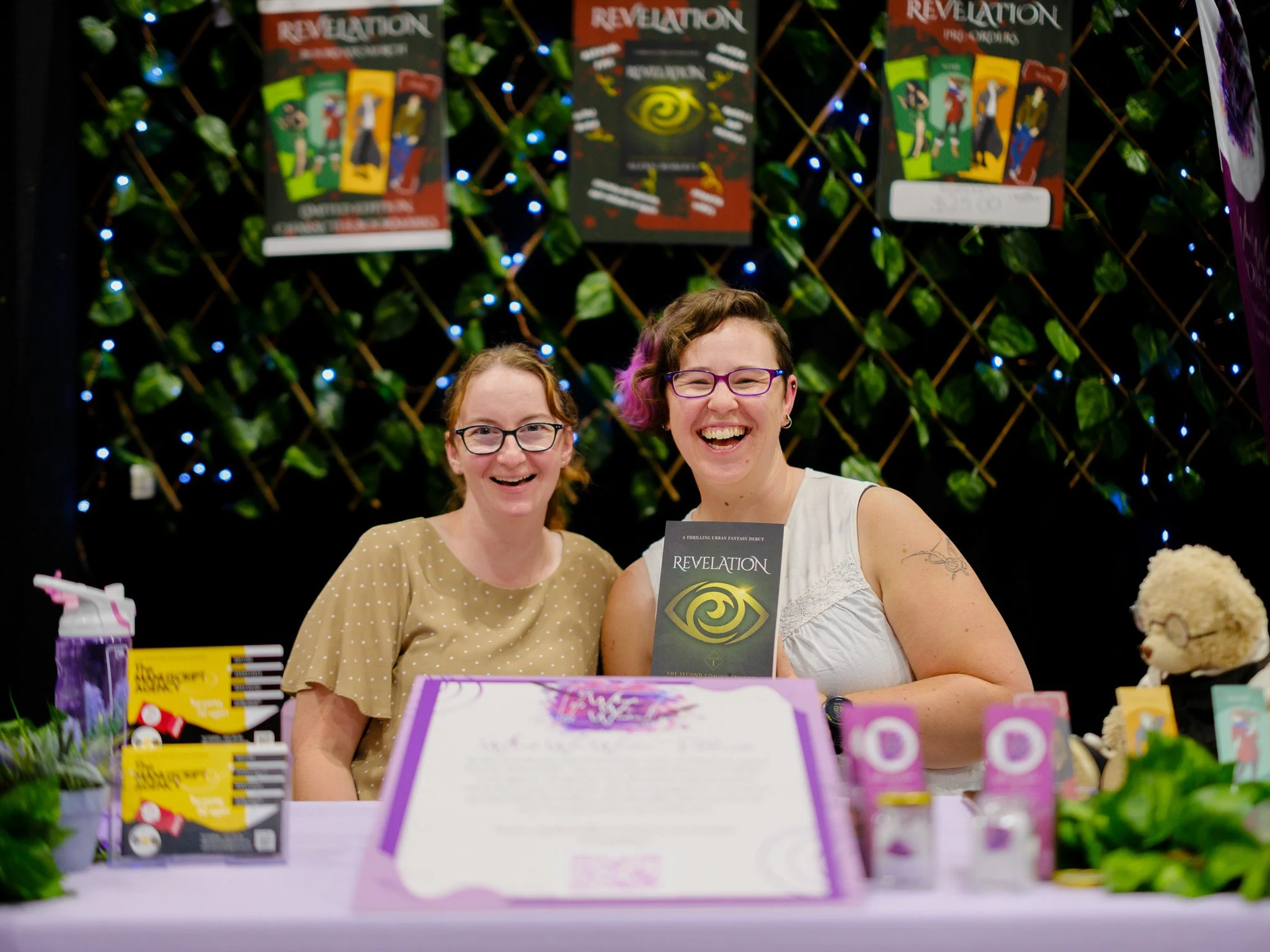
‘The second coming’ by Alexis Roberts
How do two people write one book, and make it sound like a single mind wrote every word? I’ve been asking myself this questions since 2015 when I met the two authors behind the pseudonym ‘Alexis Roberts’. I was a guest speaker on a Sydney Writers’ Festival panel in the Blue Mountains when I was approached by Emma and Esme, wanting to pick my brain about the development of their manuscript. Little did I know that they’d written the book together.
Since then, I’ve had the pleasure of appraising and editing a couple of their manuscripts, and each time the same thing struck me: the seamlessness. The sense of one cohesive storyteller, when I knew there were two. So, I finally found the time to pick their brains about their process and how they came to write together, rather than separately.
Pull up a chair as Emma and Esme share how they collaborate, how they handle the challenges of co-writing, and how they bring their stories to life as Alexis Roberts.
Let’s start by hearing a little bit about who makes ‘Alexis roberts’ …
Emma: I'm a librarian, and I currently work at the University of New South Wales in Canberra, at the new campus in Reid, and I also work as a sessional academic at Charles Sturt University. I studied Anthropology, Philosophy and Religion as an undergrad degree, then a Master of Information Science (fancy terms for a library degree) and a Masters of Human Rights through Curtin University. I've loved books and reading my whole life, but I actually wanted to be either a Museum Curator or a Historian when I was younger, because I'm a big history nerd. Unfortunately, those aren't very safe career choices in Australia, so librarian it is! I particularly love medieval British history but I'm super into old stuff in general. I read as much as I can on the way to and from work, and during my lunch break. When I'm not at work, I'm usually hanging out at home with my Labrador Leo and my two horses, Bob and Sky, who suck up the majority of my free time. I love being outside, especially on sunny days.
Kit: I love that you wanted to be a Museum Curator or a Historian when you were younger, I can’t imagine many of your peers would’ve known what those jobs were! Librarian would be a great gig though 😊
What about you, Esme?
Esme: I’m a Veterinary Nurse by day and work at a vet hospital in Lithgow. I have always loved and adored animals and Veterinary Nursing was my plan B, right after published author. When you tell your parents you want to be an author you get the ‘That’s great darling, but you should probably have a plan B’ talk. I grew up in the Blue Mountains and love spending time with my dog, a crazy Koolie called Penny, and my horses, Lexi and Bea. I also love indoor plants and have become a bit obsessed! Obviously, I'm also a big reader, though it's always hard to fit it in. So many hobbies, so little time!
Kit: I think every parent wants their kid to have a plan B. It’s great that you can live both your Plan A and Plan B life, though 😊
We should talk about your book – do you have an ‘elevator pitch’ for ‘The Second Coming’?
Our current project is The Second Coming, which we decided to turn into trilogy. It's an urban fantasy series with horror vibes, a slow burn queer romance, and heaps of action. The first book, Revelation, is the story of Merry, a young woman who can see monsters. After discovering there’s something sinister going on in Brooklyn, she falls into a world of Demons and Angels. She’s joined by Ithuriel, an enigmatic stranger who is trying to uncover the plot before the Demons take over the city, and Belial, a morally grey fallen who is playing both sides. The trio will have to learn how to trust each other and themselves if they have any chance of surviving.
Anarchy and The Second Coming follow the trio of protagonists as their road grows ever darker.
What prompted each of you to start writing, generally speaking, before you ‘got together’?
Emma: Weirdly enough I can't actually remember what prompted me to start writing per se - creating my own stories without being prompted. But I do remember the first story I wrote. I still have it! I'm pretty sure I was in about year 5, so I guess I was about 10 or 11 years old? I think it was about the time I read The Lord of the Rings for the first time. I do remember LotR blowing my mind and wanting to have that sort of power with words.
Kit: You read The Lord of the Rings at ten? Wow, I am impressed. That’s a daunting book for grown book nerds, let alone a child! 😊 What was your LotR story all about?
Emma: It was a fantasy story, about 3 pages long, about an orphan girl living in the forest who met and fell in love with the son of the local duke. And high fantasy was all I wrote for a loooonnnng time. Until the first draft of The Second Coming, actually! It was mostly what I was reading, and I enjoyed the freedom of being able to make everything up. It meant I didn’t have to worry about all that real-world nonsense. And I really haven't stopped writing since then.
Kit: What about you, Esme? How did you catch the writing bug?
Esme: Around year 5, one of my school teachers, Mrs Stephenson, used to have a “Five Minute Writing” session in class. Once a week we’d all have to write a story in five minutes, and she'd pick a few to read out. I always loved it, and I must have started writing at home as well. I wrote my first 'proper' story about my Russ toy dogs. They’d get up to all sorts of adventures while their owner was away. It was a whole series, and every time I collected one of the toys in the set, I’d write another story, introducing the new dog to gang.
Kit: I love that from a young age you were writing about animals – combining the two things you love most!
Esme: Yes 😊 After that, as I got into High School, I wrote a few ‘horse girl’ stories and, weirdly, a crime story. It was about a girl with multiple personality disorder who witnessed a crime. Though her personalities didn’t share memories with each other, so she’d only remember the murderer when that personality was present. It made sense at the time…
Kit: I think you should start that one again, I think I would read that!
Esme: Thanks 😊 Then I met Emma, who was crazy about high fantasy, so I wrote some of that as well, though it has become abundantly clear I knew nothing about the genre!

Can you tell me a little bit about what made you write The Second Coming? Where did it come from?
Esme: When we first came up with the idea for The Second Coming, we were in year 10 and we'd just finished our most recent story together — fans of our podcast will know that as All's Fair (TSC was our third story together) — and we were trying to think about what we wanted to write next. We'd been studying the poetry of W.B. Yeats in English class, and somehow we got the idea that we could build upon the idea put forth in the poem, The Second Coming. It tells of how at the end of the cycle of 2000 years, chaos will take over the world, and the antichrist will walk the earth. We thought that was a pretty cool idea. This first drafted version of the story was VERY rough, but we liked the idea enough to keep coming back to it, and here we are!
Kit: That’s wonderful, I love when other literature informs our work, it gives it more depth and connects us to our literary heritage.
How many manuscripts have you written together?
We’ve written 6 full manuscripts together, and we’ve written a heap of other stories through a variety of instant messaging apps that we don’t actually put into manuscripts. We’ve been writing this particular iteration of TSC on and off for about 15 years now. We often have multiple projects going at any given time.
You write as a duo, what does that writing process look like?
Okay, so to start with, we plot out the shape of the story together, usually on road trips (for some reason we think better while driving!). We record what we come up with in a variety of notepads that we keep in the car for this reason, or on our phones. We're prone to forgetting our ideas otherwise. Then, when it comes time to write each chapter, we sketch out the shape of each scene over instant messaging. This basically takes the form of very simple roleplaying, where each of us indicates what our character would do or say, back and forth until the scene is finished. Once this is done, whoever has to write the chapter takes this skeleton and fleshes it out into a proper piece of prose. Et voila! A chapter is born!
Kit: You must be very connected to be able to achieve this, you must really understand how each other think. Is this the case?
Apparently we are! We never really notice it until we're talking to someone we haven't spent much time with, and they keep pointing out that we finish each other's sentences. We do tend to think very similarly — we very often find ourselves coming up with the same idea independently without ever mentioning it to each other. One of us will go, "I've been thinking . . ." and the other will reply: "I was thinking the same thing!" It definitely helps being on the same page.
Kit: How does the editing/revision process work with two authors?
We edit each other’s chapters. One of us will read through it, point out what needs changing, and the other goes back and fixes it. Aside from the minor altercations over the placement of commas or syntax, it's a lot easier than editing your own work. Sometimes you're too close to your own writing to edit well. Revision pretty much works the same way we write them. We’ll sketch out together what needs to change and write out the skeleton, then the other goes back and fills it out again.
Kit: Do you find that you end up with chapters that sound rather different from each other? Or have you found that your writing style has melded over time?
The jury seems to be out on this. We think our writing is quite different from each other. Some people can tell immediately who wrote what, other people say they can't tell which chapters were written by whom. People will have to read the book and tell us what they think!
Do you guys plan what you are writing and write plot lines before writing? How to you manage the process?
Emma: We try to, these days. In the past we had a tendency to just wing it, but we always ended up with long, rambling scenes going nowhere. So now we do try and plan out our plots in advance. It doesn't always turn out that way though — our characters tend to have minds of their own, and often once we get to writing it, all hell breaks loose and we end up having to re-evaluate the plan.
Esme: I think now we have also developed a bit of a process where the first draft is just for us. We use it to get a feel for the characters, to build the world and set the scene. So when we start to knuckle down on the actual story, or the plot, we have a solid base to work from.
You worked with The MAA in the development of your manuscript, how do you feel that helped to shape your work? Would you suggest a service such as this for other authors?
We first heard of MAA at the festival where you were speaking on one of the panels. Neither of us had ever really considered an appraisal before, until we spoke to you. You were so lovely and helped us so much with just a five minute chat after the panel that we told ourselves we'd be sending her our manuscript as soon as we were done.
Honestly, working with the MAA is the best thing that we have ever done for our writing career. We had two appraisals done as well as a copy/line edit on Revelation, and Anarchy is actually off for its first appraisal right now. The appraisers who read our manuscript did such a great job of assessing what did work, what didn't work and their suggestions were invaluable. We highly recommend this sort of service for anyone, but especially if you're planning to self-publish.
It was so useful to pick up on plot holes, inconsistencies and character weaknesses. Even more so because they don't focus on just the manuscript, but actually the whole submission package, including cover letter and synopsis, which is wonderful, because we needed a LOT of help with that!
Kit: That’s so amazing to hear. My aim is that we provide a genuinely valuable service for authors, so it is really wonderful knowing that it was a positive part of your writing/publishing journey.
Speaking of publishing, I would love to know more about your self-publishing journey, what prompted you to follow that path?
Emma: The pandemic was a big turning point for us in our publication journey. We were 2/3 of the way through a re-write of Anarchy and Revelation had been appraised twice and was just waiting some final edits. We had started querying agents in late 2019 and early 2020, but of course the pandemic put all of that on hold. Es was an essential worker and so time, energy and bandwidth dropped to an all time low, and towards 2021 I was in the process of buying a property and moving 3 hours across the country. So we really didn't touch The Second Coming project for nearly 3 years. Finally, towards the end of 2023 as things started to settle down we decided to come back to it, but our patience and desire for the querying slog had sort of evaporated. In the meantime, self/indie publishing had become more and more accepted, especially with Booktok taking off. We decided we were going to just bite the bullet and self-pub. And that was when we started a podcast in the hope of creating an audience for the book!
It's been a huge learning curve, but we think it's been going pretty well! Revelation has had a great reception since its launch and we're really happy with how sales are tracking.
Esme: Self publishing is a lot of work, and we are lucky that we can share the load (and the finances!). Of course, a big trad deal is always the dream, but through self publishing we have learnt so much about the industry and how it works. We've also found that there is more and more support growing for self-published authors, especially Australian ones. Joining a writer's guild and going to events like the Book Fair Australia and Geek Expo helps to network and we are starting to find our way into a really lovely, supportive community of writers and readers.
You’ve mentioned your podcast a few times now … I’d love to know more about this. What can you tell me?
Esme: When you start looking into publishing, whether traditional or self, one of the first pieces of advice you'll get is that you need to 'build your author platform'. We had already been trying to do this, but there are so many writers and creators out there that it's a bit like shouting into the void. So, you have to really set yourself apart from the crowd.
I suggested starting a podcast, where we read out our old terrible teen writing. I thought this would be a fun way for people to get to know us, and would also be a nice way to show that everyone starts somewhere! So many people get discouraged with writing when their first few attempts don't go the way they'd envisioned, but it's all part of the process!
Emma: Initially, I was extremely doubtful. I had no faith in people wanting to listen to us or being interested in what we had to say. We had tried to do some blogging and stuff in the past with very minimal success, and we're rubbish at social media, so I thought it would be a terrible disaster. I was happy to be proven wrong! ‘What We Wrote’ has been an absolute delight to be part of, it's incredible to get to hang out with my best friend and reminisce about those early days. Even when it is deeply humbling.
Tell us what’s next for you?
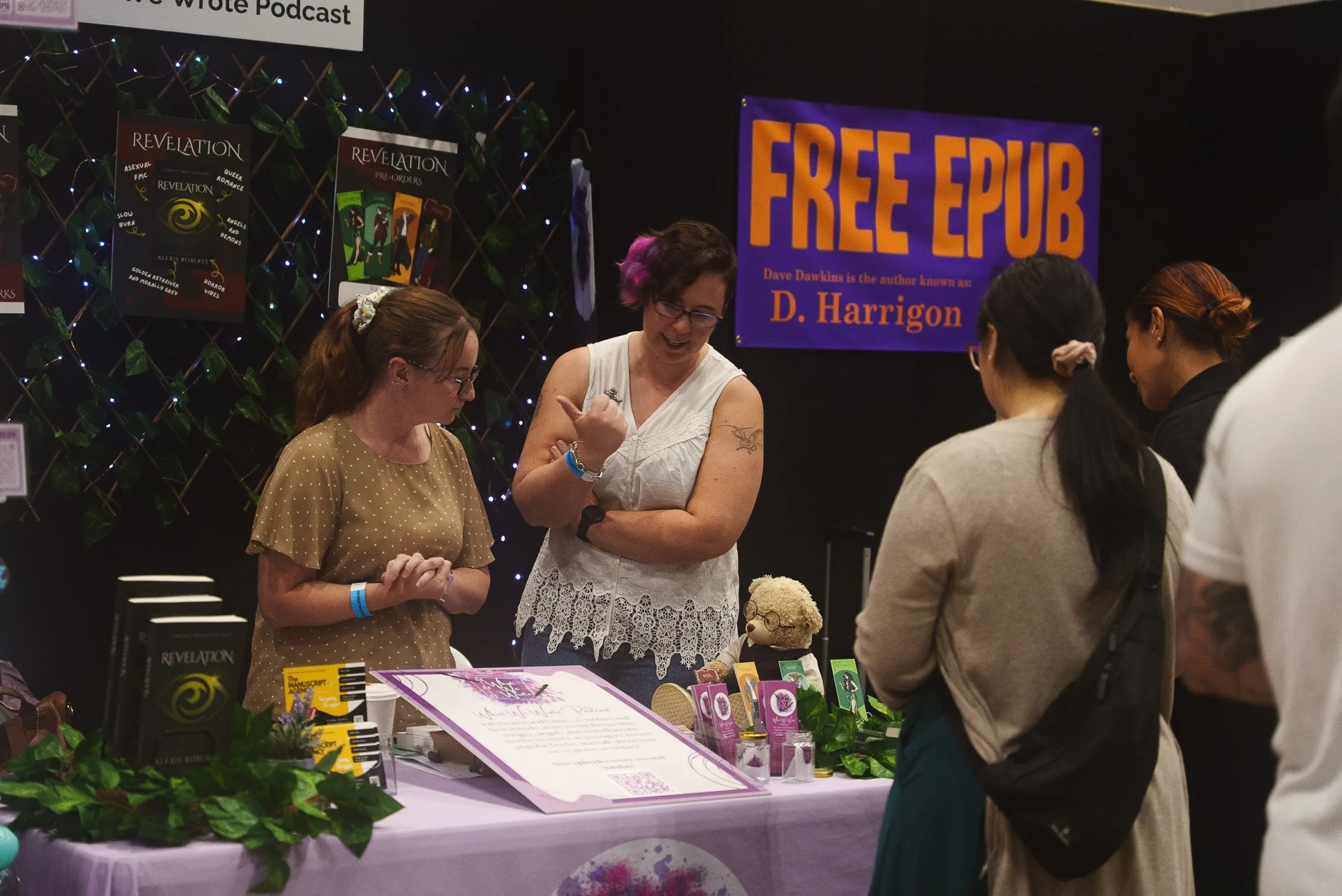
Revelation was released in February 2026, so this year has been mostly about promoting that, attending various bookish events and trying to find our audience, as well as finishing re-writes and edits on Anarchy. We're going to be at Bookfair Sydney 2026 in November and the Beyond this World Ball in the Hunter Valley in October, and then again in Canberra in March next year, so if you're attending either of those events, stop by our stall and say hi!
We're hoping to have Anarchy out early to mid-2027 and will soon be starting work on book 3. And, of course, we're going to keep recording the podcast, reading popular books for our bonus episodes, and tracking the development of our writing from those cringe early days to where we are now!
How can we find out more about you? Where can we follow your work?
You can find us on Tiktok, Instagram, Facebook, Youtube and Tumblr through the podcast account, @whatwewrotepodcast. We post clips from episodes, outtakes, snippets of the books, upcoming events, and announcements there so it's a great place to keep up to date with what we're up to! You can also email us at whatwewrotepod@gmail.com or through our website www.alexisrobertsauthor.com (which is also where you can buy a copy of Revelation).
It was such a pleasure meeting you both at the festival, and it has been such a joy travelling with you on your writing and publishing journey.
I wish you absolutely every success with your books and all your endeavours!
Thanks for joining me for this chat and sharing your journey with my readers 😊